CETUP* 2026

US/Mountain
Lead/Deadwood Middle School

Lead/Deadwood Middle School

(0.3 miles, 7 min walk from hotel)
Barbara Szczerbinska (Texas A&M University - Corpus Christi), Bhaskar Dutta (Texas A&M University), Jaret Heise (SDSTA/SURF), K.S Babu (Oklahoma State University), LOUIS STRIGARI (Texas A&M)
Description

June 22 - July 03:  Dark Matter Workshop
July 06 - July 17:  Neutrino Workshop
 
The Institute for Underground Science at SURF hosts the Center for Theoretical Underground Physics and Related Areas workshop, located in the beautiful Black Hills of South Dakota. 
 
The CETUP* Mission is to promote organized research in physics and astronomy, geoscience, and related fields of underground science worldwide via individual and collaborative research in a dynamic atmosphere of intense scientific interactions.
 

Celebrating its 10th year, CETUP* has produced more than 209 publications and become a hallmark of collaboration in underground science through an interdisciplinary approach to research. Each summer, it brings together scientists from around the world to advance theoretical and experimental research—linking directly to major experiments at the Sanford Underground Research Facility (SURF), including DUNE and LUX-ZEPLIN (LZ).


Why Attend CETUP*

CETUP* is vital to modern physics because it unites the world’s leading and emerging scientists in an immersive, collaborative environment that accelerates groundbreaking discoveries, strengthens the global research community, and directly shapes landmark experiments probing the fundamental nature and origins of the universe.


  • Intellectual community, interdisciplinary setting – Connect with theorists and experimentalists from around the world in an open, discussion-driven environment.
  • Innovative workshop format – Fewer talks and more time for deep exchange, mentorship, and hands-on collaboration.
  • Access to groundbreaking science – Engage with leading research in neutrino physics, dark matter, astronomy, geoscience, and related fields.
  • Exclusive facility tours – Visit SURF and experience world-class underground experiments firsthand.
  • Global, inclusive community – Join scientists at all career stages and from institutions worldwide. 
  • Financially accessible, family-friendly setting - Benefit from no registration fee, provided lodging and lunches, and a welcoming atmosphere for families.  
  • Education and outreach – Contribute to workforce development, student engagement, and local community outreach.
  • Inspiring location – Experience the beauty of the Black Hills alongside cutting-edge science.

Funding Support for 2026 Workshop. 

The following details outline the support provided for participants. 

Expenses Covered by the CETUP* Workshop:

  • There is no registration fee to attend, keeping the workshop as affordable and accessible as possible.

  • Up to 8 nights of lodging at The Hampton Inn in Lead, SD.

  • Weekday lunches (Monday–Friday) catered at the Lead-Deadwood Middle School.

  • Breakfast provided at The Hampton Inn for guests staying at the hotel.

Expenses You Are Responsible For:

  • Any additional lodging beyond 8 nights. 
  • Transportation to and from the airport.

  • Meals not covered by the workshop.

  • Any additional travel-related expenses.

Thank you for your interest in CETUP* and for being part of this unique experience and intellectual community.


Organizing Committee (CETUP* 2025)
Registration
Ask A Scientist volunteer (Not for Neutrino Day)
Badlands National Park invited science panel and ask a scientist booth
General Public Talk at SD Mines, Rapid City or Black Hills State Univ., Spearfish
Lead, SD Walking History Tour
Neutrino Day volunteer (Sat, July 11) - science panel, ask a scientist booth or other opportunities
Pub Talk presenter (at Dakota Shivers Brewing in Lead)
Share Your CETUP* Story – Celebrating 10 Years of Impact
Participants
    • 8:30 AM 12:00 PM
      Dark Matter Workshop: CETUP* Welcome and Talks
      Convener: LOUIS STRIGARI (Texas A&M)
      • 8:30 AM
        Registration 30m
        Speaker: Stacie Granum (SDSTA/The Institute)
      • 9:30 AM
        Break 15m
      • 10:30 AM
        Discussions and Collaborations 1h 30m
    • 12:00 PM 1:00 PM
      Lunch 1h
    • 1:00 PM 5:00 PM
      Dark Matter Workshop: CETUP* Talks and Discussions
      Convener: LOUIS STRIGARI (Texas A&M)
      • 1:00 PM
        Discussions and Collaborations 1h
      • 2:45 PM
        Break 15m
      • 3:00 PM
        TALK: TBD 45m
      • 3:45 PM
        Discussions and Collaborations 1h 15m
    • 5:00 PM 5:30 PM
      Welcome and Updates from 9:00 - 9:30 a.m. 30m Lead-Deadwood Elementary

      Lead-Deadwood Elementary

    • 8:30 AM 12:00 PM
      Dark Matter Workshop: CETUP* Talks and Discussions
      Convener: LOUIS STRIGARI (Texas A&M)
      • 9:00 AM
        Welcome and Overview 30m
        Speaker: Stacie Granum (SDSTA/The Institute)
      • 9:30 AM
        Break 15m
      • 9:45 AM
        Primordial Black Hole Dark Matter from Accretion During Early Matter Domination 45m

        Speaker: Rouzbeh Allaverdi
        Abstract: We present a scenario where primordial black holes (PBHs) formed in a radiation-dominated (RD) phase undergo significant accretion during a period of early matter dominated (EMD), as a result of which their mass can grow by up to two orders of magnitude. Restricting to the linear perturbation regime, we compute the gravitational wave (GW) spectrum that features two peaks: a high-frequency peak associated with the PBH formation in the RD phase, and a low-frequency peak due to the sudden transition from EMD to the standard RD phase. We show that one or both peaks can be observed by a combination of different GW detectors for PBHs in the asteroid mass window, where they could comprise the totality of dark matter.

        Speaker: Rouzbeh Allaverdi
      • 10:30 AM
        Break 15m
      • 10:45 AM
        TALK: TBD 45m
      • 11:30 AM
        Break 30m
    • 12:00 PM 1:00 PM
      Lunch 1h
    • 1:00 PM 5:00 PM
      Dark Matter Workshop: CETUP* Talks and Discussions
      Convener: LOUIS STRIGARI (Texas A&M)
      • 1:00 PM
        Discussions and Collaborations 1h
      • 2:00 PM
        Searching for Ultraheavy Dark Matter with Magnetically Levitated Sensors 45m

        Speaker: Juehang Qin
        Abstract: There are numerous theoretical candidates for dark matter significantly heavier than the WIMP scale (~100GeV), yet such models are less explored by experimental efforts. In this talk, I will discuss our progress searching for ultraheavy dark matter above 1 PeV in mass using a magnetically levitated setup with a 0.3mg test mass and less than 100aN/rtHz of force noise. I will present the estimated sensitivity and discuss our on-going experimental campaign and data analysis. We expect to have leading sensitivity in parts of the parameter space, and our work represents the first time a maglev sensor is being used to search for ultraheavy dark matter.

        Speaker: Juehang Qin (Rice University)
      • 2:45 PM
        Break 15m
      • 3:00 PM
        Discussions and Collaborations 2h
    • 5:00 PM 7:00 PM
      Deep Talks: Crazy Horse Memorial 2h Visitor Center

      Visitor Center

    • 9:00 AM 12:00 PM
      Dark Matter Workshop: Discussions and Collaborations
      Conveners: Barbara Szczerbinska (Texas A&M University - Corpus Christi), LOUIS STRIGARI (Texas A&M)
      • 9:00 AM
        Discussions and Collaborations 2h 45m
        Speakers: Bhaskar Dutta (Texas A&M University), LOUIS STRIGARI (Texas A&M)
      • 11:45 AM
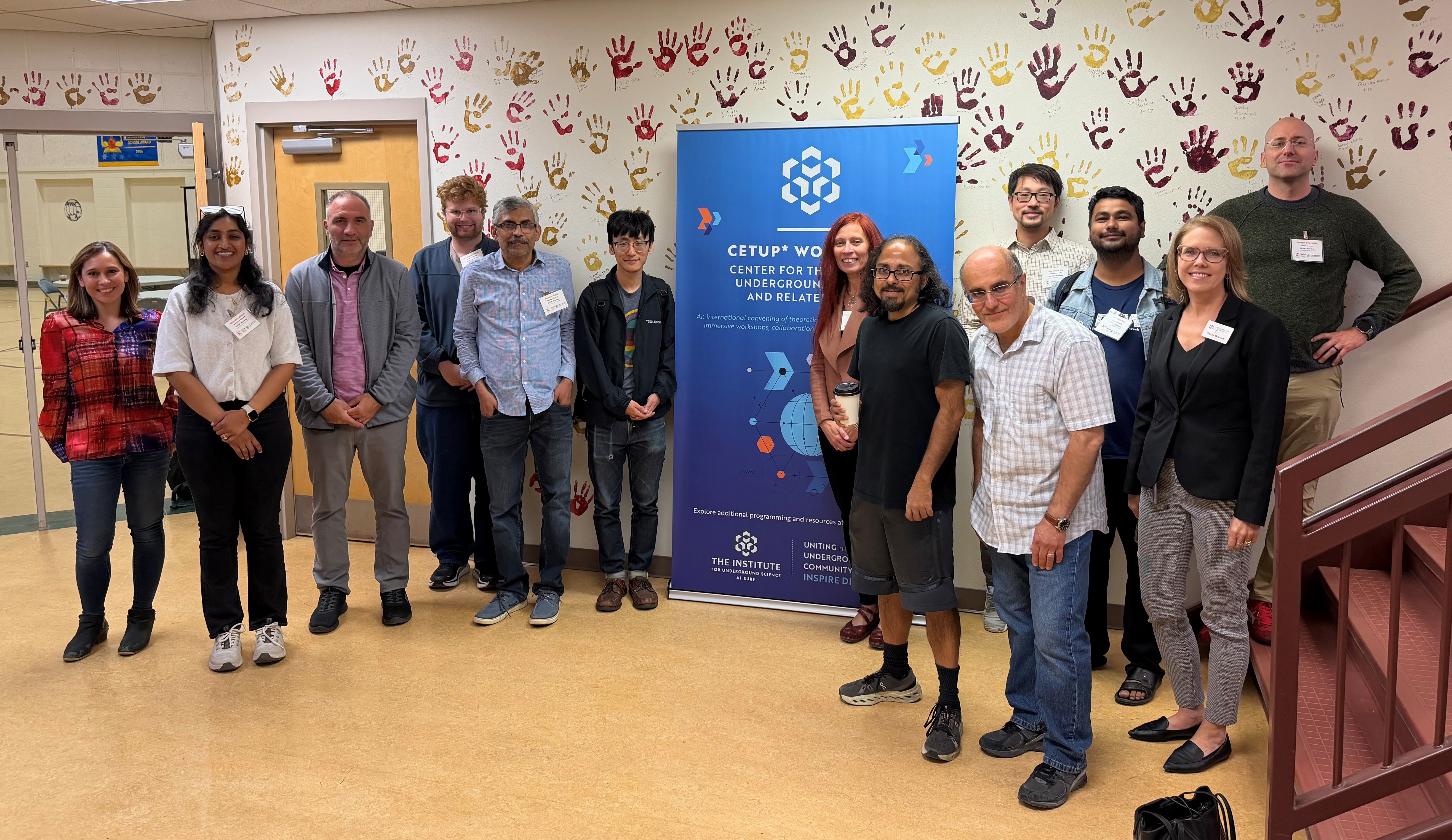
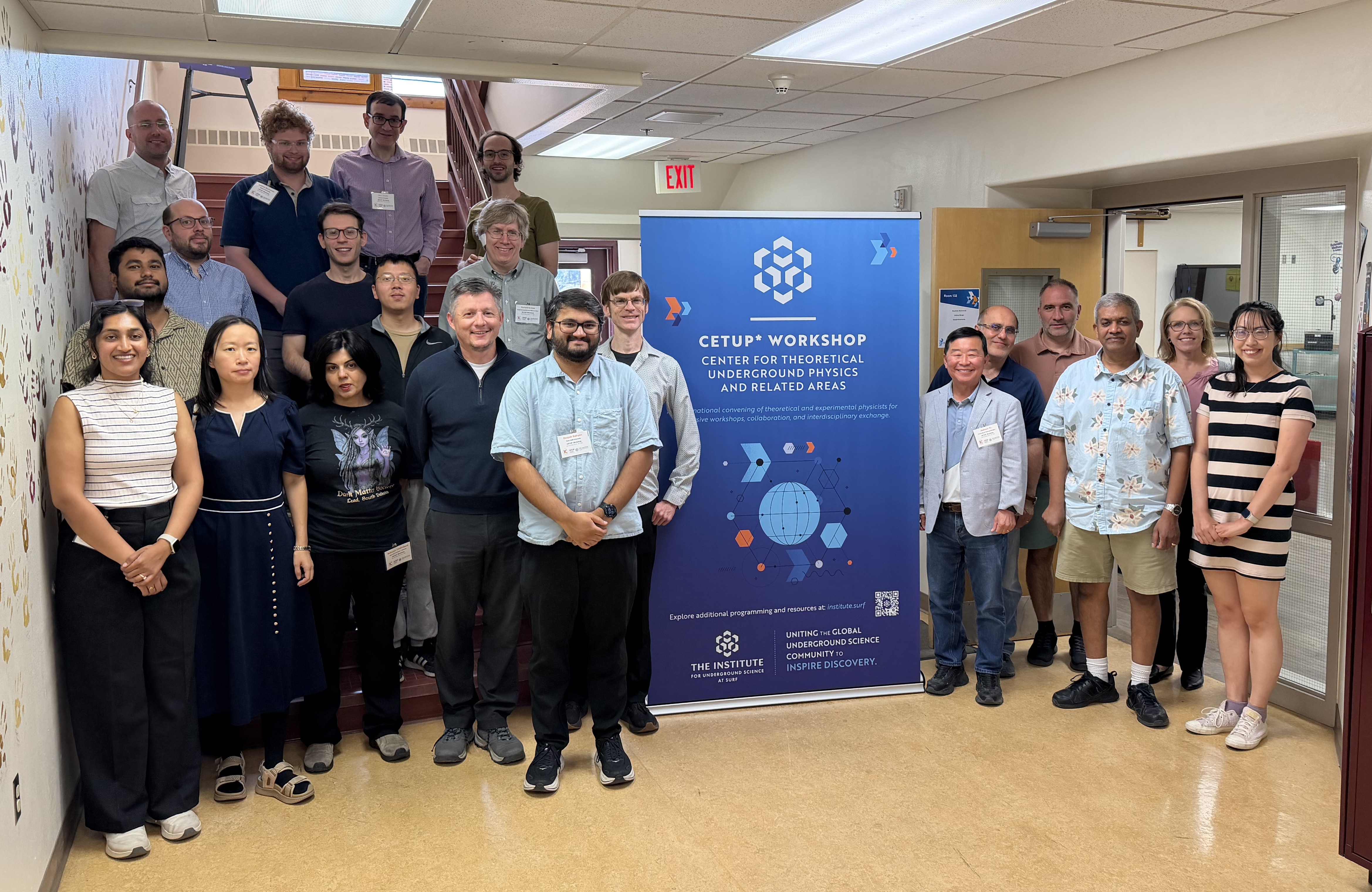
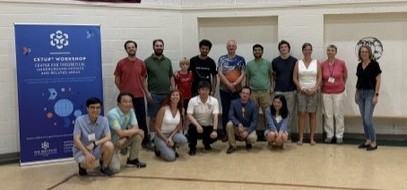
        Group Photo - meet in cafeteria on 1st floor 15m
    • 12:00 PM 1:00 PM
      Lunch 1h
    • 1:00 PM 5:00 PM
      Dark Matter Workshop: CETUP* Talks and Discussions
      Conveners: Barbara Szczerbinska (Texas A&M University - Corpus Christi), LOUIS STRIGARI (Texas A&M)
      • 1:00 PM
        Discussions and Collaborations 1h
      • 2:00 PM
        Axiogenesis and Kinetic Misalignment with Dissipation from Dark Magnetic Monopoles 45m

        Speaker: Raymond Co

        Abstract: We propose a framework in which the QCD axion simultaneously accounts for the baryon asymmetry and contributes to dark matter through its early-universe rotation. A Peccei–Quinn (PQ) field rotation corresponds to a conserved PQ charge, which can be transferred to baryon number via sphaleron processes (axiogenesis) and to the axion abundance through its kinetic energy (the kinetic misalignment mechanism). However, a rotating axion field that generates the observed baryon asymmetry via axiogenesis typically overproduces axion dark matter via kinetic misalignment. We present a model in which this excess abundance is reduced by interactions with dark magnetic monopoles. We show that monopole-axion couplings induce transitions between dyonic levels that efficiently dissipate the axion’s kinetic energy into dark fermions. The resulting cosmology features a multi-component dark matter sector consisting of axions, monopoles, and dark fermions with comparable energy densities. The viable parameter space requires an axion decay constant below ~10^9 GeV.

        Speaker: Raymond Co (Indiana University)
      • 2:45 PM
        Break 15m
      • 3:00 PM
        Discussions and Collaborations 2h
    • 6:00 PM 7:30 PM
      Walking History Tour of Lead (meet in the lobby of the Hampton Inn, Guide: Terry Smith) 1h 30m Sanford Lab Homestake Visitor Center (meet near the Davis ring outside)

      Sanford Lab Homestake Visitor Center (meet near the Davis ring outside)

      Someone from the Lead Historic Preservation Commission will be providing a special history tour of Lead, SD to CETUP* participants and their family/friends. If interested please let the workshop organizers, Stacie or Christopher know on Monday or Tuesday if you and anyone else in your party would like to join the tour. If there is no interest the tour will be cancelled; therefore, please let us know and we'll provide additional details.

      Thank you!

      https://www.leadhistoricpreservation.org/

    • 9:00 AM 12:00 PM
      Dark Matter Workshop: CETUP* Talks and Discussions
      Convener: LOUIS STRIGARI (Texas A&M)
      • 9:00 AM
        Space-based Neutron Lifetime Measurement & Update on Absolutely Calibrated Skymap at 310 MHz (30 min talk, 15 min Q&A) 45m

        Speaker: Akshatha Vydula
        Abstract: The measurement of neutron lifetime has been a project in progress for several decades, now being actively researched by many independent groups around the globe. The precise measurement of the mean lifetime of the neutron is significant to improve predictions of Big Bang Nucleosynthesis, and to constrain the search for physics beyond the Standard Model. Current laboratory measurements are accurate to 1%; however they differ by over 5 sigma that can’t be explained by statistical or systematic errors, thus the problem remains unsolved. In this talk I will show the technique of space-based neutron lifetime measurement using data from the Lunar Prospector mission, and discuss two large systematic uncertainties in such measurements (Vydula +2025).

        Additionally, I will give an update on the deployment and observation of the absolutely calibrated zero-level map of the radio emissions at 310 MHz using Green Bank Telescope. This measurement is aided by a custom under-illuminated antenna feed and a balanced correlation receiver. Such a skymap is crucial for many areas of astrophysics, including insights into CMB foregrounds, radio synchrotron background and excess radio background in the early Universe. Note that this project update was previously presented by Dr. Jack Singal in CETUP 2025.

        Speaker: Akshatha Vydula (University of Richmond)
      • 9:45 AM
        Break 15m
      • 10:00 AM
        Searching for Dark Matter in Mica 45m

        Speaker: Andrew Buchanan
        Abstract: Many models of dark matter predict the formation of extremely heavy composite particles in the early universe, with masses well in excess of 10^20 GeV. Today, the fluxes of these particles would be too low to be detectable in direct detection experiments on human timescales. This motivates searches for dark matter signatures in minerals with billion-year lifetimes. I discuss prior searches and future prospects for detecting heavy dark matter both in plastic etch detectors and in muscovite mica.

        Speaker: Andrew Buchanan (Queen's University)
      • 10:45 AM
        Discussions and Collaborations 15m
      • 11:00 AM
        We Gotta Talk About AI 45m
        Speaker: Kuver Sinha (University of Oklahoma)
      • 11:45 AM
        Break 15m
    • 12:00 PM 1:00 PM
      Lunch with SURF Education and Outreach (Teacher Professional Development group) 1h
    • 1:00 PM 5:00 PM
      Dark Matter Workshop: CETUP* Talks and Discussions
      Convener: LOUIS STRIGARI (Texas A&M)
      • 1:00 PM
        From Theory to Classroom: Translating Science for the Next Generation 1h
        Speakers: Nicol Reiner (SDSTA/SURF), Stacie Granum (SDSTA/The Institute)
      • 2:00 PM
        Axions from Stellar Nuclear Transitions 45m

        Speaker: Anupam Ray
        Abstract: It has long been realized that stars are natural laboratories for axion production via thermal processes. In this talk, I will walk you through how mono-energetic axions can be copiously produced through nuclear de-excitations inside stars. I will further discuss two promising detection strategies for these axions and show how leading sensitivity on axion interactions can be achieved using them.

        Speaker: Anupam Ray
      • 2:45 PM
        Discussion and Collaboration 2h 15m
    • 5:30 PM 7:30 PM
      Pub Talks and Trivia 2h Dakota Shivers Brewery

      Dakota Shivers Brewery

      This event is designed to bring science out of traditional academic settings and into the community, creating an informal and welcoming environment where scientists and the public can connect through conversation, curiosity, and a little friendly competition.

      Unlike a university lecture or conference presentation, this event is meant to be relaxed, engaging, and fun. The audience may include local residents, visitors, students, educators, tourists, science enthusiasts, and people who simply stopped by the brewery for an evening out.

      A CETUP* scientist will present a 30 minute "general public" focused physics related talk, followed by Q&A and Science Trivia.

      Event Format
      5:30 – 6:00 p.m.
      • Social time/mingling
      6:00 – 6:30 p.m.
      • 30-minute science talk
      • Audience questions and discussion throughout are welcome
      6:30 – 7:30 p.m.
      • Physics and science trivia
      • Additional audience questions and informal conversations

    • 9:00 AM 12:00 PM
      Dark Matter Workshop: CETUP* STUDENT DAY
      Convener: LOUIS STRIGARI (Texas A&M)
      • 9:00 AM
        Student Day: Introductions 15m
      • 9:15 AM
        Introduction to CETUP* and Underground Physics Research 45m

        Louis Strigari, co-chair of the CETUP Organizing Committee will give a talk on the purpose of CETUP, why it's important, and the impact of this collaborative workshop.

        Speaker: LOUIS STRIGARI (Texas A&M)
      • 10:00 AM
        Career Panel 45m
      • 10:45 AM
        Break 15m
      • 11:00 AM
        Scientist Mentor/Student Roundtables 1h
    • 12:00 PM 1:00 PM
      Lunch with Students 1h
    • 1:00 PM 5:00 PM
      Dark Matter Workshop: CETUP* Talks and Discussions
      Convener: LOUIS STRIGARI (Texas A&M)
      • 1:00 PM
        Where is DUNE? 45m

        Speaker: Jaehoon Yu
        Abstract: The neutrino flavor oscillation, discovered and confirmed through mid-2000s is a firmly established phenomenon. Since the flavor oscillation occurs due to the fact that the flavor and mass eigenstates differ, it requires the Standard Model to be modified. Precision measurements of the neutrino properties to reflect their non-zero mass into the Standard Model require high statistics samples of neutrino interactions. To provide the essential information for the modifications of the Standard Model, two next-generation long baseline neutrino experiments are under construction on either side of the Pacific. The Deep Underground Neutrino Experiment (DUNE) in the U.S. and the Hyper-Kamiokande (HK) experiment in Japan utilize high-power proton beams of energy 120GeV and 30GeV, respectively, together with the large mass far detectors and powerful near detectors. This talk will cover DUNE’s latest expected physics reach for neutrino oscillation properties, including the potential for the discovery of CP violation in the neutrino sector, the potential for supernova neutrino measurements, and the expanded physics reach going beyond the oscillation measurements, which becomes possible thanks to the powerful facilities these next-generation neutrino experiments utilize. This talk will also cover the status of the experiment and its latest timeline.

        Speaker: Jaehoon Yu (University of Texas at Arlington)
      • 1:45 PM
        Discussion and Collaboration 2h 15m
    • 4:30 PM 5:30 PM
      Social for CETUP* participants and friends/family (4:30-5:30 p.m.) 1h Lobby (Hampton Inn )

      Lobby

      Hampton Inn

      Light snacks and beverages will be provided by the hotel

    • 1:00 PM 3:00 PM
      Badlands National Park Visitor Center - Science Talk followed by Ask A Scientist booth 2h Theatre (Badlands National Park Visitor Center)

      Theatre

      Badlands National Park Visitor Center

      ENTRANCE: use the northeast entrance to Badlands National Park which is located off Interstate 90 at Exit 131.

      Science talk (1-2 presenters) - 1:00 pm MT - 20 minute presentation, 10 Q&A

      Ask A Scientist(1-2 people) - 1:30 pm MT - 1 1/2 hours

      Typically, from 1-3pm is the parks busiest timeframe.

      The park ranger is happy to give a guided tour to any CETUP* participants immediately following the Ask A Scientist.

      SPEAKER:
      Dr. Akshatha Vydula is a Postdoctoral Research Associate in the Department of Physics at the University of Richmond, where she is using the Green Bank Telescope in West Virginia to produce an absolutely calibrated sky map at 310 MHz. Her research explores the early Universe and the formation of the first stars and galaxies. She develops calibration and analysis tools for low-frequency radio telescopes and is part of the EDGES collaboration - the only experiment to have reported a detection of the redshifted 21 cm signal from cosmic dawn. Her work also spans modeling galactic radio recombination lines and measuring the neutron lifetime using data from NASA’s Lunar Prospector mission. Beyond research, she is passionate about outreach and making science accessible to broader audiences. She is honored with the Bharat Gaurav Puraskar and recognized as one of 35 Under 35 Non-Resident Indians by the Bharat Vikas Foundation.

      Abstract: Most of us admire the night sky visible to naked eyes, but there is an entire sky that remains hidden to our eyes. In this talk, I’ll introduce radio astronomy and how radio telescopes allow us to see the Universe in a completely different point of view. I’ll explain how neutral hydrogen emits radiation at a wavelength of 21 cm, making it possible to study the earliest eras of cosmic history, known as Cosmic Dawn. I’ll also share how large single-dish telescopes like the Green Bank Telescope are used to make radio sky maps, revealing a Universe that looks very different from what we see through optical telescopes.

      Speakers: Akshatha Vydula (University of Richmond), Stacie Granum (SDSTA/The Institute)
    • 8:30 AM 9:00 AM
      Welcome and Workshop Overview 30m

      Welcome to CETUP* with opening remarks from The Institute for Underground Science, followed by workshop logistics, resources, and an overview of special events and activities planned throughout the week.

      Speaker: Stacie Granum (SDSTA/The Institute)
    • 9:00 AM 12:00 PM
      Dark Matter Workshop: CETUP* Talks and Discussions
      Convener: LOUIS STRIGARI (Texas A&M)
      • 9:00 AM
        N^2 Coherent Quantum Detection (30min talk, 15 min Q&A) 45m

        Speaker: Joseph Bramante
        Abstract: The CATCHY experiment (Coherent Atomic Transitions in Counter-pulsed Hydrogen) is a pathfinder experiment to develop a method for amplifying weak particle interactions through macroscopic quantum coherence. Traditional astroparticle detection methods currently improve sensitivity by increasing target mass and exposure time, and at present often require tons of material and observation periods spanning decades. In contrast, a CATCHY-style detector uses two-photon excitation of parahydrogen to achieve a collective response to electromagnetic fields, with signal rates that scale as $N^2$, the square of the number of molecules in the detection volume. While standard superradiance is typically limited to micron scales by the optical wavelength, this experiment aims to establish coherence across a few centimeters. In this talk, I will talk about a framework for achieving such a macroscopic coherent quantum state and discuss its future potential as a very sensitive detector.

        Speaker: Joe Bramante (Queen's University)
      • 9:45 AM
        Break 15m
      • 10:00 AM
        Clustering with Light (but Massive) Relics 45m

        Speaker: Jason Kumar
        Abstract: We consider the effect of Light (but Massive) Relics (LiMRs) on the clustering of matter in the early Universe. We account for the fact that LiMRs which are massive enough may cluster on large length scales at early times, and may thus impact weak lensing of the cosmic microwave background (CMB) even on small angular scales. In particular, we find that LiMRs in the eV mass range (and even eV), can constitute a non-negligible component of dark matter. This opens up a class of scenarios in which energy is injected as dark radiation, but begins to redshift as matter before recombination, thus avoiding constraints on while providing an eV-range dark matter component.

        Speaker: Jason Kumar (University of Hawaii)
      • 10:45 AM
        Break 15m
      • 11:00 AM
        Discussion and Collaboration 45m
      • 11:45 AM
        Break 15m
    • 12:00 PM 1:00 PM
      Lunch 1h
    • 1:00 PM 5:00 PM
      Dark Matter Workshop: CETUP* Talks and Discussions
      Convener: LOUIS STRIGARI (Texas A&M)
      • 1:00 PM
        Discussions and Collaborations 1h
      • 2:00 PM
        Axion Remix: Landau-Zener Conversion in Multi-Axion Systems 45m

        Speaker: David Dunsky
        Abstract: Multiple axions may emerge in the low-energy effective theory of Nature. In general, the potentials describing these axion fields are non-diagonal, leading to mass mixing between axion states and rich dynamics such as level-crossings. In this talk, I will discuss the cosmological evolution of such multi-axion systems, showing how their cosmological abundances can be determined even when their mass mixing changes rapidly (ie non-adiabatically) via the Landau-Zener formalism. From this, I will show how the standard misalignment abundance prediction for the usual QCD axion gets modified by the presence of an additional axion, and how it effects haloscope searches.

        Speaker: David Dunsky (New York University)
      • 2:45 PM
        Break 15m
      • 3:00 PM
        Discussions and Collaborations 2h
    • 7:30 AM 12:30 PM
      CETUP* Excursion: SURF Underground Tour (Morning) SURF

      SURF

      • 7:30 AM
        Pickup at Hampton Inn and Travel to SURF (via SURF Shuttle) 30m Hampton Inn

        Hampton Inn

      • 8:15 AM
        SURF Overview 30m SURF E&O Conference Room

        SURF E&O Conference Room

        Speaker: Jaret Heise (SDSTA/SURF)
      • 8:45 AM
        Safety Training and Waivers (Passports as Required) 45m SURF E&O Conference Room

        SURF E&O Conference Room

      • 9:30 AM
        SURF Underground Tour PPE, Cage Down Yates at 9:45AM 30m SURF E&O Building

        SURF E&O Building

      • 10:00 AM
        SURF Underground Tour 1h 45m SURF 4850L

        SURF 4850L

      • 11:45 AM
        Return to Surface and Return PPE 30m SURF E&O Building

        SURF E&O Building

    • 12:30 PM 2:00 PM
      Lunch 1h 30m
    • 2:00 PM 5:00 PM
      Dark Matter Workshop: CETUP* Talks and Discussions
      • 2:00 PM
        Machine Learning Does it and Does it Better: Unearthing Primordial Dark-Matter Velocities from the Matter Spectrum 45m

        Speaker: Brooks Thomas
        Abstract: One effective way of learning about the production and properties of dark matter in the early universe is by extracting information about the primordial dark-matter phase-space distribution from the matter power spectrum. Recently a simple empirical formula was introduced which is capable of reproducing most of the salient features of the dark-matter phase-space distribution — even in situations in which this distribution is non-thermal, multi-modal, or exhibits other complicated features. In this talk, I examine the extent to which machine-learning techniques can improve upon this analytic approach and demonstrate that these techniques not only succeed in reconstructing the dark-matter phase-space distribution with greater accuracy, but are also applicable to a broader range of matter power spectra.

        Speaker: Prof. Brooks Thomas (Lafayette College)
      • 2:45 PM
        Break 15m
      • 3:00 PM
        Illuminating the Dark Sector at Neutrino Experiments 45m

        Speaker: Joshua Berger
        Abstract: Current and upcoming accelerator-based neutrino experiments will offer new sensitivity to the dark sector by involving the largest detectors and most intense proton beams. I will discuss several candidate dark sector models for which the leading sensitivity is found at neutrino experiments. The models I focus on include dark sector portals, boosted dark matter, and mesogenesis. I will present aspects of these models including their motivation in cosmology, the simulation of their signals, and the projected sensitivity of various neutrino experiments to these models. The work I present illustrates the power and complementarity of neutrino experiments such as those making up the Short-Baseline Neutrino Program, DUNE, Hyper-Kamiokande, and JUNO in enabling a discovery of new dark sector physics.

        Speaker: Joshua Berger (Colorado State University)
      • 3:45 PM
        Discussions and Collaborations 1h 15m
    • 5:45 PM 6:00 PM
      Click here for BHSU campus parking map - for public talk at 6:00 p.m. 15m
      Speaker: Stacie Granum (SDSTA/The Institute)
    • 6:00 PM 7:00 PM
      Public Talk: "Dark Matter - in Real Time" by Dr. Sukanya Chakrabarti, Pei-Ling Chan Endowed Chair in the Department of Physics and Astronomy at the University of Alabama Huntsville. 1h Meier Hall Auditorium (Black Hills State University)

      Meier Hall Auditorium

      Black Hills State University

      Yellow Jacket Lane (building #22 on campus map)

      Dark Matter – In Real Time

      Dark matter is believed to make up much of our Galaxy, yet its true nature remains one of astronomy's greatest mysteries. Using extremely precise measurements of tiny stellar accelerations—about the speed of a crawling baby over a decade—we can map the distribution of dark matter in the Milky Way. This talk will explore recent discoveries, including evidence for a dark matter clump near our Sun, and how future observations may help reveal what dark matter really is.

      The Institute for Underground Science at SURF presents a science talk by Dr. Sukanya Chakrabarti, Pei-Ling Chan Endowed Chair in the Department of Physics and Astronomy at the University of Alabama Huntsville. Her pioneering research uses precise measurements of stellar motions to map the distribution of mass and dark matter throughout the Milky Way.

      For more information email sgranum@sanfordlab.org.

    • 9:00 AM 12:00 PM
      Dark Matter Workshop: Dark Matter Workshop: CETUP* Talks and Discussions SLHVC/Ethnobotanical Garden

      SLHVC/Ethnobotanical Garden

      Conveners: Bhaskar Dutta (Texas A&M University), LOUIS STRIGARI (Texas A&M)
      • 9:00 AM
        Axiverse Lampposts 45m Lead-Deadwood Middle School

        Lead-Deadwood Middle School

        Speaker: David Cyncynates
        Abstract: The string axiverse predicts a unique connection between the high scales approachable only through theory and the low energies within reach of experimental verification: a multitude of light, feebly interacting axions. In order to capture the collective effects of such an axion ensemble, we model the string axiverse by N coupled axions with a simple assumption: hierarchical axion masses that arise from hierarchical instantons with statistically distributed axion couplings. In this limit, we find that axion field ranges, which determine late-time cosmological abundances, shrink as sqrt(N) as the number of axions grows. Moreover, the heaviest modes tend to align with the smallest kinetic eigenvalues, further reducing their field ranges. Interactions with the Standard Model (SM) are largely set by the kinetic structure and do not grow with N, thus suppressing detection prospects relative to the individual-axion expectation. The exceptions are the ensemble's lightest and heaviest states as well as the Quantum Chromodynamics (QCD) axion, which incur no such suppression. We further find that coupled axiverse dark matter has parametrically relaxed tuning on initial conditions when produced via long, low-scale inflation relative to independent axions and high-scale inflation. Taken together, these results sharpen the observational outlook: the most accessible signals typically come from the QCD axion and from heavy axions that make up small dark matter subcomponents. An anthropic plateau of comparable energy density states produces subdominant signals; meanwhile, if light axions have SM interactions independent of QCD, they can also be within reach of future direct-detection experiments.

        Speaker: David Cyncynates (University of Washington, Seattle)
      • 9:45 AM
        Break 15m Lead-Deadwood Middle School

        Lead-Deadwood Middle School

      • 10:00 AM
        The Precision Frontier of Dark Matter Constraints from Direct Acceleration Measurements 45m Lead-Deadwood Middle School

        Lead-Deadwood Middle School

        Speaker: Sukanya Chakrabarti
        Abstract: For over a century, our understanding of dark matter has hinged on kinematic estimates derived from static snapshots of stellar positions and velocities. However, these methods are inaccurate for a time-dependent potential, and there are now many lines of observational evidence that show that our Galaxy has had a highly dynamic history. Recent technological advancements now empower us to carry out precision time-series measurements of the acceleration of stars that live within the gravitational potential of our Galaxy. This presentation outlines our comprehensive observational strategy to directly measure Galactic accelerations. Central to this discussion is our recent analysis of compiled pulsar timing data from which we were able to measure the Galactic acceleration for the first time, and derive fundamental Galactic parameters, including the local dark matter density. Discernible differences in sub-structure exist among popular dark matter models on small scales, presenting testable nuances. I will discuss our recent constraints on a dark matter sub-halo near the Sun, and the potential for measuring dark matter sub-structure in the Milky Way by leveraging the diverse set of techniques we have developed, including pulsar timing, eclipse timing, and extreme-precision radial velocity observations. I will end by discussing synergies between Galactic dark matter constraints and constraints on theories of gravity.

        Speaker: Sukanya Chakrabarti
      • 10:45 AM
        Break 15m Lead-Deadwood Middle School

        Lead-Deadwood Middle School

      • 11:00 AM
        Gamma rays from the Inner galaxy and the galactic halo region 45m Lead/Deadwood Middle School

        Lead/Deadwood Middle School

        Speaker: Ilias Cholis
        Abstract: I will discuss about recent results and ongoing studies of the gamma-ray sky from low latitudes and up to 60 degrees in latitude and at energies between 0.3 to 900 GeV. With my collaborators we search for a possible emission signal from dark matter within the inner 10 kiloparsec of the Milky Way. That includes the Inner Galaxy and the region of the Galactic Stellar Halo. We model the galactic diffuse emission, the isotropic extragalactic gamma-ray background, the known emission from Fermi Bubbles and from Loop I and properly mask the Fermi-LAT Collaboration point sources. Recent studies of Galactic surveys, such as Gaia, have revealed that the Milky Way’s gravitational potential comes from a matter distribution that is triaxial and rotated with respect to the Galactic center-Sun axis. I will present results where we tested if the morphology of the Galactic Center Excess (GCE) is compatible with a dark matter annihilation signal coming with a triaxial dark matter halo (titled and untitled to the Sun-Galactic Center axis). We find that the GCE spectrum and inner cuspiness are robust against variations in the triaxiality and tilt of the dark matter halo. In terms of its overall morphology, the GCE in the gamma-ray data can discriminate between choices for the dark matter halo’s triaxiality and
        tilt. Finally, I will present preliminary results on tests on a recent claim in the literature of an emission at high latitudes that is compatible with a dark matter annihilation signal, beyond the more well known GCE.

        Speaker: Ilias Cholis (Oakland Univeristy)
      • 11:45 AM
        Break 15m Lead/Deadwood Middle School

        Lead/Deadwood Middle School

    • 12:00 PM 1:00 PM
      Lunch - Group Photo 1h
    • 1:00 PM 5:00 PM
      Dark Matter Workshop: CETUP* Talks and Discussions
      Conveners: Bhaskar Dutta (Texas A&M University), LOUIS STRIGARI (Texas A&M)
      • 1:00 PM
        Discussions and Collaborations 1h
      • 2:00 PM
        Detecting Millicharged Particles from Supernovae 45m

        Author: Yanou Cui
        Abstract: Core-collapse supernovae (CCSNe) can copiously produce millicharged particles (MCPs) through plasmon decay and electron-positron annihilation in their hot, dense cores. Because MCPs are massive, their arrival at Earth is delayed relative to the neutrino burst by an amount that depends on the MCP mass, with delays ranging from days to years. This delayed arrival opens a clean observational window in terrestrial detectors after the neutrino signal has passed. We compute the expected electron-recoil signals at XENONnT, JUNO, DUNE, and Hyper-K for a Galactic supernova, and derive the corresponding sensitivity. We show that a future Galactic supernova can probe regions of MCP parameter space beyond existing constraints from supernova-cooling.

        Speaker: Yanou Cui (UC Riverside)
      • 2:45 PM
        Break 15m
      • 3:00 PM
        Discussions and Collaborations 2h
    • 9:00 AM 12:00 PM
      Dark Matter Workshop: CETUP* Talks and Discussions
      Conveners: Bhaskar Dutta (Texas A&M University), LOUIS STRIGARI (Texas A&M)
      • 9:00 AM
        Producing the GeV Galactic Center Excess via Cosmic Ray-Dark Matter Scattering 45m

        Speaker: Deepak Sathyan
        Abstract: In this work, we propose a novel mechanism for generating gamma rays from the Galactic Center via scattering of cosmic-ray protons off dark matter in the Milky Way halo, in contrast to conventional explanations based on dark matter annihilation. We present two examples of this framework that produce an observable photon signal. In the inelastic dark matter model, cosmic rays up-scatter a lighter dark matter particle, with the subsequent decay of the heavier particle yielding two photons. In the elastic dark matter model, an energetic photon is directly produced in the final state of a 2-to-3 scattering process. We show that, for a range of viable model parameters, this framework provides a fit to the observed Galactic Center gamma-ray excess spectrum comparable to those obtained from dark matter annihilation and millisecond pulsar models. Our results open a new avenue for interpreting gamma-ray observations of the Galactic Center.

        Speaker: Deepak Sathyan (Texas A&M University)
      • 9:45 AM
        Break 15m
      • 10:00 AM
        Axion Domain Wall, Phase Transition and Electroweak Baryogenesis 45m

        Speaker: Kunfeng Lyu
        Abstract: This talk will discuss how axion domain walls can play an role in early-Universe cosmology. First, I will show that a strongly supercooled MeV–GeV first-order phase transition can reshape QCD axion cosmology: reheating flattens the axion potential, induces mini kinetic misalignment, and could potentially generate QCD axion domain walls in the pre-inflationary case. Second, I will discuss electroweak baryogenesis from collapsing ALP domain walls, where wall motion across electroweak phases sources an effective baryon chemical potential and produces the observed baryon asymmetry without a strong first-order electroweak phase transition. These mechanisms provide new connections among axions, baryogenesis, phase transitions, and gravitational-wave signals.

        Speaker: Dr Kunfeng Lyu (University of Oklahoma)
      • 10:45 AM
        Break 15m
      • 11:00 AM
        TALK: TBD 45m
      • 11:45 AM
        Break 15m
    • 12:00 PM 1:00 PM
      Lunch 1h
    • 1:00 PM 5:00 PM
      Dark Matter Workshop: Science Communications/CETUP* Talks and Discussions
      Conveners: Bhaskar Dutta (Texas A&M University), LOUIS STRIGARI (Texas A&M)
      • 1:00 PM
        Science Communications 1h 30m

        Over the past few years, we've included discussions on science communication as part of the workshop, primarily focused on working with the media. This year, we'd like to broaden that conversation to include effective advocacy for science and research at the federal level, while also connecting those strategies to interactions with funding agencies, state leaders, and public audiences.

        SURF's Media Relations Manager, Mike Ray, will moderate the discussion, and panelists will share insights, lessons learned, and best practices for communicating the value of science and research.

        The session will be conversational and interactive. Mike will provide a brief introduction, followed by short remarks from each panelist, a moderated discussion, and audience Q&A.

        Speakers: Brianna Mount, Frank Strieder (South Dakota School of Mines & Technology), Jaehoon Yu (University of Texas at Arlington)
      • 2:30 PM
        Dark Matter During First-Order Phase Transitions 45m

        Speaker: Peisi Huang
        Abstract: We consider a dark sector consisting of fermionic dark matter (DM) charged under a broken dark gauge symmetry, interacting with the Standard Model through kinetic mixing. In such models, the DM annihilation cross section is typically suppressed by the small kinetic mixing and or a heavy mediator, often leading to an overabundant relic density. We show that the observed DM abundance can be achieved if the dark Higgs undergoes a strong first order phase transition after DM freeze-out. In this scenario, the relic abundance is set by thermal freeze-out in the symmetric phase and subsequently reduced by entropy injection from the phase transition, rather than by annihilation in the broken phase. We find that to reproduce the observed relic abundance, the required phase transition is generically supercooled. The resulting stochastic gravitational wave signal lies within the sensitivity of future experiments, providing a complementary probe of this framework. Moreover, a strongly supercooled phase transition can potentially account for the NANOGrav signal for DM masses below O(10) GeV.

        Speaker: Peisi Huang (University of Nebraska-Lincoln)
      • 3:15 PM
        Discussions and Collaborations 1h 45m
    • 5:30 PM 7:30 PM
      Pub Talks and Trivia 2h Dakota Shivers Brewery

      Dakota Shivers Brewery

      This event is designed to bring science out of traditional academic settings and into the community, creating an informal and welcoming environment where scientists and the public can connect through conversation, curiosity, and a little friendly competition.

      Unlike a university lecture or conference presentation, this event is meant to be relaxed, engaging, and fun. The audience may include local residents, visitors, students, educators, tourists, science enthusiasts, and people who simply stopped by the brewery for an evening out.

      A CETUP* scientist will present a 30 minute "general public" focused physics related talk, followed by Q&A and Science Trivia.

      Event Format
      5:30 – 6:00 p.m.
      • Social time/mingling
      6:00 – 6:30 p.m.
      • 30-minute science talk
      • Audience questions and discussion throughout are welcome
      6:30 – 7:30 p.m.
      • Physics and science trivia
      • Additional audience questions and informal conversations

    • 9:00 AM 12:00 PM
      Dark Matter Workshop: Discussion and Collaboration Board Room (Hampton Inn)

      Board Room

      Hampton Inn

      Convener: LOUIS STRIGARI (Texas A&M)
      • 9:00 AM
        Discussion and Collaboration 3h Board Room

        Board Room

        Hampton Inn

    • 12:00 PM 1:00 PM
      Lunch on your own 1h
    • 1:00 PM 5:00 PM
      Dark Matter Workshop: Discussion and Collaboration Board Room (Hampton Inn)

      Board Room

      Hampton Inn

      Convener: LOUIS STRIGARI (Texas A&M)
      • 1:00 PM
        Discussions and Collaborations 4h
    • 7:00 AM 5:00 PM
      Independence Day! America's 250th Anniversary! (see the Tourism and Other Resources tab) 10h
    • 8:30 AM 12:00 PM
      Neutrino Workshop: CETUP* Welcome and Talks
      Conveners: Bhaskar Dutta (Texas A&M University), K.S Babu (Oklahoma State University)
      • 8:30 AM
        Registration 30m
      • 9:00 AM
        Welcome and Workshop Overview 30m

        Welcome to CETUP* with opening remarks from The Institute for Underground Science, followed by workshop logistics, resources, and an overview of special events and activities planned throughout the week.

        Speaker: Stacie Granum (SDSTA/The Institute)
      • 9:30 AM
        Break 15m
      • 9:45 AM
        Neutrino Mass Induced Neutron-Antineutron Oscillation 45m

        Speaker: Shaikh Saad
        Abstract: In this talk, I will focus on how neutrino mass generation mechanisms can inherently induce neutron–antineutron (n–n) oscillations in simple extensions of the Georgi–Glashow grand unified model. I will outline the connection between |∆L| = 2 interactions that give rise to Majorana neutrino masses and the resulting |∆B| = 2 processes, discuss how these oscillations emerge in various seesaw and radiative models, and highlight the broader implications for baryon number violation beyond the Standard Model.

        Speaker: Shaikh Saad
      • 10:30 AM
        Discussion and Collaboration 1h 30m
    • 12:00 PM 1:00 PM
      Lunch 1h
    • 1:00 PM 5:00 PM
      Neutrino Workshop: CETUP* Talks and Discussions
      Conveners: Bhaskar Dutta (Texas A&M University), K.S Babu (Oklahoma State University)
      • 1:00 PM
        Discussions and Collaborations 1h
      • 2:00 PM
        Pushing the Low-Energy Neutrino Frontier 45m

        Speaker: Bhupal Dev
        Abstract: The lowest-energy neutrinos detected to date are those produced in the solar proton–proton (pp) chain, with energies above approximately 200 keV. The Sun is also expected to emit an even lower-energy flux of thermal neutrinos at the keV scale, generated through standard electroweak processes in the solar plasma. Despite their fundamental connection to solar physics, these thermal neutrinos have so far remained undetected. We show that thermal solar neutrinos are kinematically accessible to large-volume dark matter direct-detection experiments through electron-ionization signals. Using recent data from the XENONnT experiment, we derive the first upper limit on the thermal solar neutrino flux, constraining it to be below 10^8 times the Standard Model prediction. Future experiments such as XLZD could improve this sensitivity by several orders of magnitude. Although a detection remains out of reach with the current technology, our results establish future low-threshold direct-detection experiments as a promising avenue for probing the lowest-energy neutrino sources in astrophysics. This opens a new observational window on stellar interiors and could also provide a novel test of beyond-the-Standard-Model physics at the low-energy neutrino frontier.

        Speaker: Bhupal Dev (Washington University in St. Louis)
      • 2:45 PM
        Break 15m
      • 3:00 PM
        Complementarity Between Neutrino Neutral and Charged Current Events in the Search for New Physics 45m

        Speaker: Julia Gehrlein
        Abstract: At long-baseline neutrino experiments, neutral-current (NC) events accumulate in large numbers but are seldom exploited for new physics searches. We demonstrate their potential using non-standard neutrino interactions (NSI) with quarks as a case study. Charged-current (CC) analyses constrain NSI through matter effects on neutrino propagation, which probe almost exclusively the isoscalar combination of up- and down-quark couplings; the orthogonal isovector combination is suppressed by a factor of ∼100. Because NSI also modify NC cross sections in a flavor-dependent way, NC events become sensitive to oscillations: the far-to-near detector ratio acquires a dependence on the beam’s flavor composition that probes both isoscalar and isovector couplings with comparable weight. Using existing NOvA data and DUNE projections, we derive the first bounded constraints on isovector NSI from a long-baseline experiment and show that combining CC and NC measurements resolves the individual quark couplings, breaking a degeneracy that persists in either analysis alone.

        Speaker: Julia Gehrlein (Colorado State University)
      • 3:45 PM
        Discussions and Collaborations 1h 15m
    • 9:00 AM 12:00 PM
      Neutrino Workshop: CETUP* Talks and Discussions
      Conveners: Bhaskar Dutta (Texas A&M University), K.S Babu (Oklahoma State University)
      • 9:00 AM
        Ultra-High-Energy Neutrino Anomaly across Anita-IV, KM3NeT, and IceCube 45m

        Speaker: Dibya Sankar Chattopadhyay
        Abstract: The ANITA-IV experiment has reported four anomalous upgoing neutrino-candidate events with energies above 1 EeV and arrival directions implying propagation through at least several hundred kilometers of Earth. More recently, the KM3NeT Collaboration reported KM3-230213A, an exceptionally energetic event consistent with a parent neutrino in the (0.1-1) EeV range. The absence of comparable events in IceCube is particularly intriguing, given IceCube’s substantially larger total exposure. In this talk, I first quantify this discrepancy within Standard-Model-like interpretations under both diffuse all-sky and transient-source scenarios. For a diffuse Standard Model interpretation, I show that the ANITA-IV events would correspond to an upward fluctuation of ~7. I then quantify the tension for rare transient populations distributed uniformly across the sky over IceCube’s ~15 year runtime. Finally, I discuss whether beyond-the-Standard-Model modifications involving sterile-to-active neutrino conversions that are enhanced in the presence of matter effects can alleviate this tension, and place the ANITA-IV vs. IceCube anomaly in the broader context of the recent ultra-high-energy event reported by KM3NeT.

        Speaker: Dibya Sankar Chattopadhyay (Oklahoma State University)
      • 9:45 AM
        Break 15m
      • 10:00 AM
        Cosmological constraints on pseudo-Dirac neutrinos 45m

        Speaker: Chee Sheng Fong
        Abstract: In this talk, I will review the possibility of neutrinos being pseudo-Dirac and discuss cosmological constraints from CMB and BBN on this scenario.

        Speaker: Chee Sheng Fong (Universidade Federal do ABC)
      • 10:45 AM
        Break 15m
      • 11:00 AM
        How to interpret supernova neutrino data without knowing the source in detail 45m

        Speaker: Yago Porto
        Abstract:Supernova neutrinos are often described as an exceptionally informative signal, but what a nearby Galactic event will certainly provide is not information itself, but data. Whether high-statistics data can be converted into reliable physical inference depends on how strongly the interpretation relies on detailed source modeling. In this talk, I will discuss three observables designed to remain meaningful under minimal assumptions about the supernova source: the neutronization burst, whose origin is controlled by simple weak-interaction physics; the flavor composition at Earth, which can be constrained through coarse-grained multi-detector flavor measurements; and the gamma-ray echo, which can act as an astrophysical near detector for the post-conversion
        fluence at the stellar surface. Together, these examples show how the next Galactic supernova could be used not only to collect a large data set, but to perform robust consistency checks and potentially identify unexpected neutrino physics even with limited knowledge of the source.

        Speaker: Yago Porto (Technical University of Munich)
      • 11:45 AM
        Break 15m
    • 12:00 PM 1:00 PM
      Lunch 1h
    • 1:00 PM 5:00 PM
      Neutrino Workshop: CETUP* Talks and Discussions
      Conveners: Bhaskar Dutta (Texas A&M University), K.S Babu (Oklahoma State University)
      • 1:00 PM
        Discussions and Collaborations 1h
      • 2:00 PM
        TALK: TBD 45m
      • 2:45 PM
        Break 15m
      • 3:00 PM
        Discussions and Collaborations 2h
    • 9:00 AM 12:00 PM
      Neutrino Workshop: CETUP* Talks and Discussions
      Conveners: Bhaskar Dutta (Texas A&M University), K.S Babu (Oklahoma State University)
      • 9:00 AM
        John Bahcall Colloquium - Application of QIS in Subatomic Physics 45m Sanford Lab Homestake Visitor Center

        Sanford Lab Homestake Visitor Center

        Speaker: Baha Balantekin
      • 9:45 AM
        Break 15m Lead/Deadwood Middle School

        Lead/Deadwood Middle School

        (0.3 miles, 7 min walk from hotel)
      • 10:00 AM
        Probing Light Scalar Neutrino Interactions with High-Energy Astrophysical Neutrinos 45m

        Speaker: Ankur Verma
        Abstract: Scalar Non-Standard interaction (SNSI) of neutrinos contributes as modifications to the neutrino mass matrix in the oscillation Hamiltonian and can induce a small active-sterile mass splitting due to the matter effect via a Majorana-type interaction. This framework leads to pseudo-Dirac behavior of neutrinos, introducing rich phenomenology in neutrino oscillations, particularly
        for high-energy astrophysical neutrinos. These hyperfine active-sterile splittings imprint themselves in two complementary ways on high-energy astrophysical neutrino flux, modifying the flavor composition and energy distribution. The matter effects induced by SNSI with relic neutrinos modify the predicted flavor ratios of high-energy astrophysical neutrinos compared with the standard oscillation expectations. The same hyperfine splittings also modulate the energy dependence of the flux, altering both the diffuse spectrum (tracks and cascades) and the reconstructed spectra of individual point sources. In this work, we exploit both sources to probe light scalar NSI. We confront the predictions with current IceCube measurements and with the projected reach of next-generation detectors such as IceCube-Gen2. The regions excluded by the combined flavor and spectral analyses are translated into limits on the underlying model parameters: Yukawa couplings and scalar mass, providing new sensitivities/constraints on the parameter space of light scalar NSI.

        Speaker: Ankur Verma (Texas A&M University)
      • 10:45 AM
        Discussions and Collaborations 1h 15m Lead/Deadwood Middle School

        Lead/Deadwood Middle School

        (0.3 miles, 7 min walk from hotel)
    • 12:00 PM 1:00 PM
      Lunch (Group photo before lunch) 1h
    • 1:00 PM 4:30 PM
      Neutrino Workshop: Science Communications/CETUP* Talks and Discussions
      Conveners: Bhaskar Dutta (Texas A&M University), K.S Babu (Oklahoma State University)
      • 1:00 PM
        Science Communication 1h 30m

        Over the past few years, we've included discussions on science communication as part of the workshop, primarily focused on working with the media. This year, we'd like to broaden that conversation to include effective advocacy for science and research at the federal level, while also connecting those strategies to interactions with funding agencies, state leaders, and public audiences.

        SURF's Media Relations Manager, Mike Ray, will moderate the discussion, and panelists will share insights, lessons learned, and best practices for communicating the value of science and research.

        The session will be conversational and interactive. Mike will provide a brief introduction, followed by short remarks from each panelist, a moderated discussion, and audience Q&A.

        Speakers: Andre De Gouvea, Brianna Mount, Frank Strieder
      • 2:30 PM
        Break 15m
      • 2:45 PM
        Oscillation-Independent Probes of Non-Standard Neutrino Interactions from Supernovae 45m

        Speaker: Anna Suliga
        Abstract: In this talk I will show how the non-standard neutrino-quark interactions affect the pre-neutrinozation neutrino signal from the core-collapse supernova. I will demonstrate how the neutral-current channels in the large-scale neutrino detectors and large-scale dark matter detectors are ideal to identify such signals as they resist neutrino flavor conversions degeneracies and experience opposing NSI cross section effects.

        Speaker: Anna Suliga (New York University)
      • 3:30 PM
        Discussion and Collaboration 30m
    • 4:30 PM 5:30 PM
      Social for CETUP* participants and friends/family (4:30-5:30 p.m.) 1h Lobby (Hampton Inn)

      Lobby

      Hampton Inn

      Light snacks and beverages will be provided by the hotel

    • 6:00 PM 7:30 PM
      Walking History Tour of Lead (optional) 1h 30m Hampton Inn lobby

      Hampton Inn lobby

      Someone from the Lead Historic Preservation Commission will be providing a special history tour of Lead, SD to CETUP* participants and their family/friends. If interested please let the workshop organizers, Stacie or Christopher know on Monday or Tuesday if you and anyone else in your party would like to join the tour. If there is no interest the tour will be cancelled; therefore, please let us know and we'll provide additional details.

      Thank you!

      https://www.leadhistoricpreservation.org/

    • 9:00 AM 12:00 PM
      Neutrino Workshop: CETUP* Talks and Discussions
      Conveners: Bhaskar Dutta (Texas A&M University), K.S Babu (Oklahoma State University)
      • 9:00 AM
        Neutrino masses and leptogenesis in the VISHnu axion-majoron model 45m

        Speaker: Raymond Volkas
        Abstract: VISHnu is a flavour-variant DFSZ axion model where the type-1 seesaw neutrino mass scale is identified with the Peccei-Quinn breaking scale. So, as well as solving the strong-CP problem and providing a viable axion-majoron dark matter candidate, it also explains why neutrino masses are tiny and provides an economical mechanism for generating the baryon asymmetry of the universe through leptogenesis. A key feature is inflation driven by a non-minimal coupling of the Peccei-Quinn scalar to the Ricci scalar. Results about how reheating can proceed through inflaton-neutrino coupling will also be briefly presented.

        Speaker: Raymond Volkas (University of Melbourne)
      • 9:45 AM
        Break 15m
      • 10:00 AM
        Quantum Sensing of Radiative Decay Photons with Superconducting Qubits 45m

        Speaker: Doojin Kim
        Abstract: Radiative decays of weakly interacting particles can produce extremely faint photons in the micro-eV range, corresponding to GHz-scale microwave signals. This energy scale naturally matches the transition frequencies of superconducting qubits. In this talk, I will discuss how transmon qubits can be used as resonant quantum sensors for such rare decay photons. Starting from the classical and quantum descriptions of LC resonators, I will explain how Josephson-junction nonlinearity leads to an anharmonic two-level system, how an electromagnetic signal drives Rabi oscillations, and how the resulting transition probability can be converted into an event-rate estimate. I will then discuss sensitivity prospects for radiative decays of dark matter and neutrinos, including possible enhancements from reflective cavities, effective volume scaling, repeated measurements, and collective quantum protocols.

        Speaker: Doojin Kim (University of South Dakota)
      • 10:45 AM
        Break 15m
      • 11:00 AM
        TALK: TBD 45m
      • 11:45 AM
        Break 15m
    • 12:00 PM 1:00 PM
      Lunch 1h
    • 1:00 PM 5:00 PM
      Neutrino Workshop: CETUP* Talks and Discussions
      Conveners: Bhaskar Dutta (Texas A&M University), K.S Babu (Oklahoma State University)
      • 1:00 PM
        Discussions and Collaborations 1h
      • 2:00 PM
        Status of GLIMPSE and Angular Scanning 45m

        Speaker: Jong-Chul Park
        Abstract: We propose a novel detection strategy for super-light dark matter (DM), m_DM ~ O(keV), using a detector based on Graphene Josephson Junctions (GJJ). By intimately integrating the π-bond electrons of graphene as the target material into a Josephson junction, we create a sensor capable of detecting energy deposits as small as O(meV). We evaluate the scattering rates between DM and free electrons in the two-dimensional graphene, incorporating Pauli-blocking factors and in-medium screening effects. Our analysis of pg- to µg-scale detectors demonstrates that this setup achieves superior experimental sensitivity due to its extremely low energy threshold. Furthermore, we demonstrate that this 2D direct detection framework allows for the determination of the DM mass scale through directionality observables. Due to the relative motion of the Earth through the Galactic DM halo, the event rates depend non-trivially on the orientation of the graphene plane relative to the DM flux. We show that the curvature of this resulting angular spectrum encodes critical information about the particle mass. By validating these theoretical expectations through numerical analysis of the GJJ detector, we establish that this platform serves not only as a highly sensitive probe for the discovery of super-light DM but also as a precision instrument for measuring its fundamental properties.

        Speaker: Jong-Chul Park (Chungnam National University)
      • 2:45 PM
        Break 15m
      • 3:00 PM
        Discussions and Collaborations 2h
    • 5:30 PM 7:30 PM
      CETUP* Pub Talks and Trivia 2h Dakota Shivers Brewery

      Dakota Shivers Brewery

      This event is designed to bring science out of traditional academic settings and into the community, creating an informal and welcoming environment where scientists and the public can connect through conversation, curiosity, and a little friendly competition.

      Unlike a university lecture or conference presentation, this event is meant to be relaxed, engaging, and fun. The audience may include local residents, visitors, students, educators, tourists, science enthusiasts, and people who simply stopped by the brewery for an evening out.

      A CETUP* scientist will present a 30 minute "general public" focused physics related talk, followed by Q&A and Science Trivia.

      Event Format
      5:30 – 6:00 p.m.
      • Social time/mingling
      6:00 – 6:30 p.m.
      • 30-minute science talk
      • Audience questions and discussion throughout are welcome
      6:30 – 7:30 p.m.
      • Physics and science trivia
      • Additional audience questions and informal conversations

    • 9:00 AM 12:00 PM
      Neutrino Workshop: CETUP* Talks and Discussions
      Conveners: Bhaskar Dutta (Texas A&M University), K.S Babu (Oklahoma State University)
      • 9:00 AM
        Exploring the MeV Frontier in Neutrino Experiments 45m

        Speaker: Vishvas Pandey
        Abstract: The highly capable liquid-argon neutrino experiments, including the Short-Baseline Neutrino (SBN) Program and the Deep Underground Neutrino Experiment (DUNE), offer unique opportunities to explore physics at the MeV scale. In this talk, I will highlight the broad scientific potential of MeV-scale physics, spanning neutrino-interaction studies, solar and supernova neutrino detection, and searches for physics beyond the Standard Model. Together, these efforts expand the discovery potential of liquid-argon detectors and will help maximize their scientific impact far beyond their primary oscillation programs.

        Speaker: Vishvas Pandey (Fermilab)
      • 9:45 AM
        Break 15m
      • 10:00 AM
        TALK: TBD 45m
      • 10:45 AM
        Break 15m
      • 11:00 AM
        TALK: TBD 45m
      • 11:45 AM
        Break 15m
    • 12:00 PM 1:00 PM
      Lunch 1h
    • 1:00 PM 5:00 PM
      Neutrino Workshop: CETUP* Talks and Discussions
      Conveners: Bhaskar Dutta (Texas A&M University), K.S Babu (Oklahoma State University)
      • 1:00 PM
        Discussions and Collaborations 1h
      • 2:00 PM
        TALK: TBD 45m
      • 2:45 PM
        Break 15m
      • 3:00 PM
        Discussions and Collaborations 2h
    • 5:00 PM 7:00 PM
      Neutrino Day Kick-Off Reception 2h SLHVC

      SLHVC

    • 8:00 AM 5:00 PM
      Neutrino Day (CETUP* Participants welcome to attend and/or volunteer); Event Website: https://neutrinoday.com/ 9h Lead, SD

      Lead, SD

    • 8:30 AM 12:00 PM
      Neutrino Workshop: CETUP* Talks and Discussions
      Conveners: Barbara Szczerbinska (Texas A&M University - Corpus Christi), K.S Babu (Oklahoma State University)
      • 8:30 AM
        Welcome and Workshop Overview 30m

        Welcome to CETUP* with opening remarks from The Institute for Underground Science, followed by workshop logistics, resources, and an overview of special events and activities planned throughout the week.

        Speaker: Stacie Granum (SDSTA/The Institute)
      • 9:00 AM
        New Supernova Bounds on a Neutrinophilic Dark Sector (30 min talk, 15 min Q&A) 45m

        Speaker: Christopher Cappiello
        Abstract: Supernova cooling has long been used to constrain physics beyond the Standard Model, typically including new mediators or dark matter particles that couple to protons or electrons. The large density of neutrinos inside supernovae also makes supernovae powerful laboratories to study non-standard neutrino interactions. In this work, we consider supernova production of dark matter that couples dominantly to neutrinos. We show that, for a wide range of unconstrained parameter space, neutrino annihilation within a supernova could copiously produce dark matter, at a large enough rate to cause noticeable anomalous cooling. We thus set novel constraints on dark matter-neutrino interactions based on the non-observation of such anomalously high cooling.

        Speaker: Christopher Cappiello
      • 9:45 AM
        Break 15m
      • 10:00 AM
        Probing Supernova Neutrino Emission Anisotropy and Long-Baseline Effects 45m

        Speaker: Garv Chauhan

        Speaker: Garv Chauhan (Arizona State University)
      • 10:45 AM
        Break 15m
      • 11:00 AM
        Probing neutrino-electron non-standard interactions in Borexino 45m

        Speaker: Aldo Ianni
        Abstract: Non-standard neutrino interactions (NSIs) provide a powerful probe of physics beyond the Standard Model. In this talk, we present a search for neutrino--electron NSIs using data collected with the Borexino detector.
        Thanks to its exceptionally low radioactive background and high sensitivity to low-energy solar neutrinos, Borexino offers a unique opportunity to investigate NSIs, particularly through the monoenergetic 0.862 MeV 7Be solar neutrinos.
        After a brief overview of the Borexino detector, we describe the analysis strategy employed to search for neutrino--electron NSIs. The analysis is sensitive to all 12 neutrino--electron NSI coupling parameters, comprising six left-handed and six right-handed couplings.
        Despite the large parameter space, the Borexino spectral analysis allows all 12 NSI parameters to be fitted simultaneously, yielding competitive constraints that are consistent with the Standard Model expectation of vanishing NSI couplings.

        Speaker: Aldo Ianni
      • 11:45 AM
        Break 15m
    • 12:00 PM 1:00 PM
      Lunch 1h
    • 1:00 PM 5:00 PM
      Neutrino Workshop: CETUP* Talks and Discussions
      Conveners: Barbara Szczerbinska (Texas A&M University - Corpus Christi), K.S Babu (Oklahoma State University)
      • 1:00 PM
        Discussions and Collaborations 1h
      • 2:00 PM
        Neutrinos, Muons and Charm Production in the Atmosphere 45m

        Speaker: Mary Hall Reno
        Abstract: The role of cosmic ray-air production of charm and its decay in the high energy atmospheric neutrino and muon fluxes is discussed. We consider enhanced charm production in the atmosphere as a mechanism better match IceCube's muon flux data, and we discuss the resulting tensions with IceCube's upper bound on the atmospheric neutrino flux.

        Speaker: Mary Hall Reno (University of Iowa)
      • 2:45 PM
        Break 15m
      • 3:00 PM
        High-Energy Neutrino Flavor State Transition Probabilities 45m

        Speaker: John Harrison
        Abstract: We analytically determine neutrino transitional probabilities and abundance ratios at various distances from the source of creation in several astrophysical contexts, including the Sun, supernovae and cosmic rays. In doing so, we determine the probability of a higher-order transition state from 𝜈_𝜏 → 𝜈_𝜆, where 𝜈_𝜆 represents a more massive generation than Standard Model neutrinos. We first calculate an approximate cross-section for high-energy neutrinos which allows us to formulate comparisons for the oscillation distances of solar, supernova and higher-energy cosmic ray neutrinos. The flavor distributions of the resulting neutrino populations from each source detected on Earth are then compared via fractional density charts. We analytically determine neutrino transitional probabilities and abundance ratios at various
        distances from the source of creation in several astrophysical contexts, including the Sun, supernovae and cosmic rays. In doing so, we determine the probability of a higher-order transition state from 𝜈_𝜏 → 𝜈_𝜆, where 𝜈_𝜆 represents a more massive generation than Standard Model neutrinos. We first calculate an approximate cross-section for high-energy neutrinos which allows us to formulate comparisons for the oscillation distances of solar, supernova and higher-energy cosmic ray neutrinos. The flavor distributions of the resulting neutrino populations from each source detected on Earth are then compared via fractional density charts.

        Speaker: John Harrison
      • 3:45 PM
        Discussions and Collaborations 1h 15m
    • 7:30 AM 12:30 PM
      CETUP* Excursion: SURF Underground Tour (Morning) Sanford Underground Research Facility

      Sanford Underground Research Facility

      • 7:30 AM
        Pickup at Hampton Inn and Travel to SURF (via SURF Shuttle) 30m Hampton Inn

        Hampton Inn

      • 8:15 AM
        SURF Overview 30m SURF E&O Conference Room

        SURF E&O Conference Room

        Speaker: Jaret Heise (SDSTA/SURF)
      • 8:45 AM
        Safety Training and Waivers (Passports as Required) 45m SURF E&O Conference Room

        SURF E&O Conference Room

      • 9:30 AM
        SURF Underground Tour PPE, Cage Down Yates at 9:45AM 30m SURF E&O Building

        SURF E&O Building

      • 10:00 AM
        SURF Underground Tour 1h 45m SURF 4850L

        SURF 4850L

      • 11:45 AM
        Return to Surface and Return PPE 30m SURF E&O Building

        SURF E&O Building

    • 12:30 PM 2:00 PM
      Lunch 1h 30m
    • 2:00 PM 5:00 PM
      Neutrino Workshop: CETUP*: Talks and Discussion
      • 2:00 PM
        TALK: TBD 45m
      • 2:45 PM
        Break 15m
      • 3:00 PM
        TALK: TBD 45m
      • 3:45 PM
        Discussions and Collaborations 1h 15m
    • 6:00 PM 7:00 PM
      Public Talk at SD Mines, Rapid City by Anil Thapa from Colorado State University 1h Classroom Building 104E (SD Mines, Rapid City)

      Classroom Building 104E

      SD Mines, Rapid City

      The Institute for Underground Science at SURF presents a science talk by Dr. Anil Thapa, a theoretical particle physicist who studies neutrinos as a window into physics beyond the Standard Model. His research focuses on understanding the origin of neutrino masses and identifying experimental signatures that can be tested in current and future particle physics experiments, including underground and intensity-frontier searches.
      His recent work focuses on neutrino electromagnetic properties and new mechanisms for generating neutrino masses. Dr. Thapa has authored more than thirty peer-reviewed research articles and has been a returning participant in CETUP at the Sanford Underground Research Facility, where theorists and experimentalists come together to explore the physics potential of underground science. He is also active in mentoring and outreach, including through BCVSPIN programs that support students and early-career researchers in particle physics and cosmology.

      abstract to follow.

    • 9:00 AM 12:00 PM
      Neutrino Workshop: CETUP* Talks and Discussions SLHVC/Ethnobotanical Garden

      SLHVC/Ethnobotanical Garden

      Conveners: Barbara Szczerbinska (Texas A&M University - Corpus Christi), K.S Babu (Oklahoma State University)
      • 9:00 AM
        Supernova neutrino detection at DUNE: how to obtain precision and how to probe ultralight dark matter 45m Lead-Deadwood Middle School

        Lead-Deadwood Middle School

        Speaker: Ting Cheng
        Abstract: The DUNE far detector offers a unique, flavor- and helicity-tagged view of neutrinos from a Galactic core-collapse supernova, with particular sensitivity to the supernova $\nu_e$ spectrum. In this talk, I will first discuss how to obtain precision measurements of this spectrum using a data-driven strategy that calibrates the uncertain $\nu_e$-argon cross section with solar and muon-decay-at-rest neutrinos as standard candles. With this helicity tagging, complementary to the antineutrino sensitivity of other supernova detectors through inverse beta decay, we can measure neutrino-antineutrino asymmetries as a probe of ultralight vector dark matter coupled to lepton number, such as $U(1){B-L}$ or $U(1){L_i-L_j}$.

        Speaker: Tim Cheng
      • 9:45 AM
        Break 15m Lead-Deadwood Middle School

        Lead-Deadwood Middle School

      • 10:00 AM
        The origin of neutrino mass bounds: backgrounds versus perturbations 45m Lead-Deadwood Middle School

        Lead-Deadwood Middle School

        Speaker: Toni Bertolez-Matinez
        Abstract: In this talk, we will understand the physical effects that neutrino masses have in cosmological observables, and through which measurements cosmological observations place the most stringent bounds on neutrino masses as of today. Then, I will show how CMB bounds can be relaxed not only by a different assumption on the cosmological model, but by non-standard properties of the neutrino sector. At a time when observations point towards "negative neutrino masses" and evolving dark energy, we require a framework which allows to quantify which properties of neutrinos in cosmology we are actually measuring.

        Speaker: Toni Bertolez-Martinez (University of Wisconsin-Madison)
      • 10:45 AM
        Break 15m SURF

        SURF

      • 11:00 AM
        TALK: TBD 45m Lead/Deadwood Middle School

        Lead/Deadwood Middle School

      • 11:45 AM
        Break 15m Lead/Deadwood Middle School

        Lead/Deadwood Middle School

    • 12:00 PM 1:00 PM
      Lunch (Group Photo before Lunch) 1h
    • 1:00 PM 5:00 PM
      Neutrino Workshop: CETUP* Talks and Discussions
      Conveners: Barbara Szczerbinska (Texas A&M University - Corpus Christi), K.S Babu (Oklahoma State University)
      • 1:00 PM
        Discussions and Collaborations 1h
      • 2:00 PM
        TALK: TBD 45m
      • 2:45 PM
        Break 15m
      • 3:00 PM
        Discussions and Collaborations 2h
    • 6:00 PM 7:30 PM
      Walking History Tour of Lead (optional) 1h 30m Hampton Inn lobby

      Hampton Inn lobby

      Someone from the Lead Historic Preservation Commission will be providing a special history tour of Lead, SD to CETUP* participants and their family/friends. If interested please let the workshop organizers, Stacie or Christopher know on Monday or Tuesday if you and anyone else in your party would like to join the tour. If there is no interest the tour will be cancelled; therefore, please let us know and we'll provide additional details.

      Thank you!

      https://www.leadhistoricpreservation.org/

    • 9:00 AM 12:00 PM
      Neutrino Day: CETUP* Talks and Discussions
      Conveners: Barbara Szczerbinska (Texas A&M University - Corpus Christi), K.S Babu (Oklahoma State University)
      • 9:00 AM
        TALK: TBD 45m
      • 9:45 AM
        Break 15m
      • 10:00 AM
        From Theory to Classroom: Translating Science for the Next Generation 1h
        Speaker: Nicol Reiner (SDSTA/SURF)
      • 11:00 AM
        Discussions and Collaborations 1h
    • 12:00 PM 1:00 PM
      Lunch 1h
    • 1:00 PM 5:00 PM
      Neutrino Workshop: CETUP* Talks and Discussions
      Conveners: Barbara Szczerbinska (Texas A&M University - Corpus Christi), K.S Babu (Oklahoma State University)
      • 1:00 PM
        Discussions and Collaborations 1h
      • 2:00 PM
        TALK: TBD 45m
      • 2:45 PM
        Break 15m
      • 3:00 PM
        TALK: TBD 45m
      • 3:45 PM
        Discussions and Collaborations 1h 15m
    • 5:30 PM 7:30 PM
      CETUP* Pub Talks and Trivia 2h Dakota Shivers Brewery

      Dakota Shivers Brewery

      This event is designed to bring science out of traditional academic settings and into the community, creating an informal and welcoming environment where scientists and the public can connect through conversation, curiosity, and a little friendly competition.

      Unlike a university lecture or conference presentation, this event is meant to be relaxed, engaging, and fun. The audience may include local residents, visitors, students, educators, tourists, science enthusiasts, and people who simply stopped by the brewery for an evening out.

      A CETUP* scientist will present a 30 minute "general public" focused physics related talk, followed by Q&A and Science Trivia.

      Event Format
      5:30 – 6:00 p.m.
      • Social time/mingling
      6:00 – 6:30 p.m.
      • 30-minute science talk
      • Audience questions and discussion throughout are welcome
      6:30 – 7:30 p.m.
      • Physics and science trivia
      • Additional audience questions and informal conversations

    • 9:00 AM 12:00 PM
      Neutrino Workshop: CETUP* Student Day and Career Panel
      Conveners: Barbara Szczerbinska (Texas A&M University - Corpus Christi), K.S Babu (Oklahoma State University)
      • 9:00 AM
        Student Introductions 15m
      • 9:15 AM
        CETUP* Participants Presentation 45m
      • 10:00 AM
        Career Panel 45m
      • 10:45 AM
        Break 15m
      • 11:00 AM
        Scientist Mentor/Student Roundtable 1h
    • 12:00 PM 1:00 PM
      Lunch with Students 1h
    • 1:00 PM 5:00 PM
      Neutrino Workshop: CETUP* Talks
      Conveners: Barbara Szczerbinska (Texas A&M University - Corpus Christi), K.S Babu (Oklahoma State University)
      • 1:00 PM
        Discussion and Collaboration 1h
      • 2:00 PM
        TALK: TBD 45m
      • 2:45 PM
        Break 15m
      • 3:00 PM
        TALK: TBD 45m
      • 3:45 PM
        Discussions and Collaboration 1h 15m
    • 3:00 PM 5:00 PM
      Badlands National Park Visitor Center (AstroFest Weekend) - Science Talk and Ask A Scientist booth 2h Theatre (Badlands National Park )

      Theatre

      Badlands National Park

      ENTRANCE: use the northeast entrance to Badlands National Park which is located off Interstate 90 at Exit 131.

      Location of talk: Ben Reifel Visitor Center at Badlands National Park

      Science talk (1-2 presenters) - 3:00 pm MT - 20 minute presentation, 10 Q&A

      Ask A Scientist(1-2 people) - 3:30 pm MT - 1 1/2 hours (flexible)

      July 17-19 (Fri-Sun) is the park's AstroFest event. More information here: https://www.nps.gov/thingstodo/badl-astronomy-festival.htm

      Speaker: Stacie Granum (SDSTA/The Institute)