3rd Annual Higher Education Connections Workshop

US/Mountain
Sanford Lab Homestake Visitors Center

Sanford Lab Homestake Visitors Center

160 W Main St. Lead, SD 57754
Jaret Heise (SDSTA/SURF), Stacie Granum (SDSTA/The Institute)
Description

COLLABORATIVE CAPACITY BUILDING.

CONNECT. COLLABORATE. MOVE IDEAS FORWARD.

The 3rd Annual Higher Education Connections Workshop, hosted by The Institute for Underground Science at the Sanford Underground Research Facility (SURF), will bring together higher education leaders, researchers, STEM and education faculty, and partners from across South Dakota, November 1–3, 2026, in Lead, South Dakota.

This year’s workshop is focused on Collaborative Capacity Building, moving from connections and conversation to collaboration and action. Participants will explore shared priorities, identify opportunities to work across institutions, and develop ideas that can strengthen research, education, workforce development, and innovation across South Dakota.

Through featured speakers, facilitated discussions, concept sharing, and interactive working sessions, the workshop will create dedicated space to explore not only what we can accomplish together, but how we can begin moving those opportunities forward.

(NO registration fee and lunch provided Monday)

THE WORKSHOP IS STRUCTURED AROUND THREE GOALS: 

CONNECT  Build Relationships. Share Expertise. Discover Opportunities.

COLLABORATE  Build Capacity. Develop Ideas. Create Partnerships.

ACT  Turn Ideas Into Action.


Participants will have opportunities to identify shared challenges and opportunities, develop potential initiatives, connect with needed partners, and define actionable next steps to carry forward after the workshop.

EXPLORE OPPORTUNITIES AROUND

  • Collaborative Research & Grant Development — Build research connections, explore multi-institution opportunities, and strengthen approaches to collaborative funding.
  • AI in Research & Education — Explore how AI is shaping research, teaching, and learning across higher education.
  • Student Research & Workforce Pathways — Identify opportunities to strengthen undergraduate research, experiential learning, and workforce development.
  • Shared Expertise & Resources — Connect complementary expertise, initiatives, and resources across institutions.
  • Cross-Institution Partnerships — Develop new relationships and ideas that can grow into meaningful collaboration beyond the workshop.


EVENT DETAILS

Dates: Sunday, November 1 – Tuesday, November 3, 2026
Location: Sanford Lab Homestake Visitor Center and Sanford Underground Research Facility | Lead, South Dakota

Sunday, November 1 | CONNECT
Build relationships, share expertise, explore South Dakota’s higher education and research ecosystem, and identify potential connections and opportunities.

Monday, November 2 | COLLABORATE
Explore collaborative research and funding, student research and workforce pathways, AI and emerging opportunities, followed by facilitated working sessions to begin developing ideas.

Tuesday, November 3 | ACT
Move promising ideas toward action by identifying priorities, partners, next steps, and opportunities for continued collaboration.

Bring your ideas, challenges, and expertise to the table, and leave with new connections, potential partners, and opportunities to move forward.


WHO SHOULD ATTEND?

Higher education leaders, researchers, STEM and education faculty, and partners interested in strengthening collaboration across South Dakota’s research, education, and STEM ecosystem are encouraged to participate.

2025 Participant Feedback

"I was able to network and meet new colleagues from high ed institutions and SURF. It was a chance to find out what all of us were doing. Coming in a cohort from our university meant we could strategize together."
 
"I have started collaborating on a research idea I initiated at SURF."


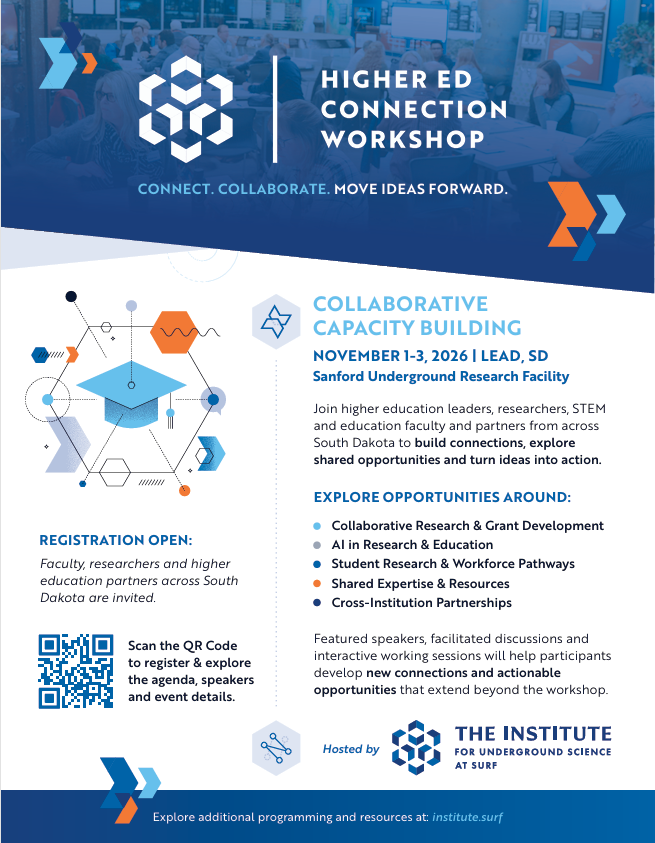
DOWNLOAD THE FLYER PDF FILE BELOW (next to the paperclip), PRINT AND SHARE WITH OTHER STEM AND EDUCATION FACULTY: 
 

Registration
Higher Education Connections Workshop Registration Form
    • 1
      Welcome and Workshop Goals

      Theme: Collaborative Capacity Building
      Workshop Purpose: Strengthen collaboration across South Dakota’s higher education ecosystem to advance shared priorities, expand funding opportunities, and drive actionable outcomes.

    • 2
      From Institutional Strengths to Statewide Capacity: A Vision for SD Higher Education

      Building South Dakota’s Capacity Through Higher Education Collaboration
      How can higher education institutions and partners work collectively to strengthen research, education and workforce capacity?

      Building South Dakota’s Innovation Economy: Connecting Research, Talent and Economic Development
      How can those collective capabilities translate into talent development, innovation, industry partnerships and economic growth?

    • 2:30 PM
      Break
    • 3
      Breaking Down Silos: Who's Doing What? + Idea Pitches.

      Breaking Down the Silos
      Each institution or organization present, share the following information. (up to 3 slides allowed)

      Who's Doing What? and A Short Pitch.
      📌Who you are, including who's in attendance
      📌Highlight expertise, research interests, initiatives and resources across institutions
      📌Identify areas of complementary expertise and potential collaboration
      📌Short concept pitches from participants (include research ideas, emerging initiatives and collaboration needs and who you are interested in collaborating with, if applicable).

    • 4:00 PM
      Welcome Reception & Connections

      Light appetizers and beverages will be provided.

    • 4
      Breaking Down Silos: Who's Doing What? + Idea Pitches.

      Breaking Down the Silos (continued)
      Each institution or organization present, share the following information. (up to 3 slides allowed)

      Who's Doing What? and A Short Pitch.
      📌Who you are, including who's in attendance
      📌Highlight expertise, research interests, initiatives and resources across institutions
      📌Identify areas of complementary expertise and potential collaboration
      📌Short concept pitches from participants (include research ideas, emerging initiatives and collaboration needs and who you are interested in collaborating with, if applicable).

    • 10:30 AM
      Break
    • 5
      Funded Projects (Progress, Success, Challenges)

      Funded Projects: Progress, Success, Challenges
      📌Federal Programs
      📌HECW Incubator Projects

      Better understand:
      •Federal and statewide funding landscape
      •EPSCoR and other collaborative opportunities
      •Building stronger multi-institution proposals
      •Grant development, support and shared resources

    • 12:00 PM
      Lunch

      Lunch will be provided.

    • 6
      From Classroom to Career: Building South Dakota's STEM Talent Pipeline (panel)

      Panel Discussion

      From Classroom to Career: Building South Dakota's STEM Talent Pipeline

      Higher Education Perspective: How should South Dakota's higher-education institutions evolve to prepare students for STEM careers that are changing rapidly? Address the university's role in creating a talent pipeline—not simply educating students but connecting education → research → experiential learning → industry → careers.

      K-12/Student Pathways Perspective: How do we get more young South Dakotans to see themselves in STEM, particularly students in rural and underserved communities, and create pathways that carry that interest from K–12 into college and careers? Building early STEM interest, supporting educators, reaching rural students and creating K–12-to-college STEM pathways.

      Employer Perspective: What employers actually need, and what they need education to do differently. What does an engineering and technology employer need from graduates, and how can employers become more involved in developing that talent before students graduate?

      Student Perspective: The Student Experience: Navigating the STEM Pathway. What does that pathway actually look like from the student’s perspective? What experiences make the biggest difference, and what barriers or gaps make it harder to navigate? How did you become interested in STEM? Who or what opened doors for you? How did you find internships, research or other experiential opportunities? What has helped you understand possible careers? What do you wish you had known earlier? What could universities, employers and K–12 educators do differently?

    • 7
      AI Across Education: Navigating Opportunity, Responsibility and Change.

      AI Across Education: Navigating Opportunity, Responsibility and Change.

      What could South Dakota's K–12 and higher education communities do together to prepare students for an AI-enabled future?

      📌Higher Education Perspective:
      AI in Research — How is AI changing how faculty conduct research, analyze information, collaborate and generate new ideas? What opportunities and concerns should researchers be thinking about?

      AI in Teaching & Learning — How should faculty respond when students already have these tools? How can AI enhance learning without replacing critical thinking? How does assessment need to change?

      Responsible & Effective Use — What guardrails are needed around accuracy, academic integrity, privacy, intellectual property and transparency? And how do institutions create enough flexibility to innovate while still using AI responsibly?

      📌K-12 Perspective:
      How do we prepare K–12 students to use AI thoughtfully, responsibly and effectively—and ensure they arrive at college prepared for an environment where AI is already part of learning, research and work?

      AI Literacy & Student Readiness — What should students understand about AI before they graduate from high school? How do we teach students to question outputs, recognize limitations and bias, verify information, and use AI as a tool rather than a substitute for thinking?

      Teaching & Learning in K–12 — How are teachers incorporating AI into classrooms? What does effective use look like at different grade levels? How do educators balance access to these tools with developing foundational skills, creativity and critical thinking?

      Equity, Access & Teacher Preparedness — Are all South Dakota students getting similar opportunities to learn about and use AI? What challenges are particularly relevant for rural schools? What training and support do teachers need to prepare students for an AI-enabled future?

    • 3:00 PM
      Break
    • 8
      Group 1: Collaborative Research & Funding

      Participants move from discussion to development through facilitated working sessions around priority areas.

      GROUP 1:
      • Collaborative research & funding

      Each group identifies:
      • A shared opportunity or challenge
      • Potential initiative(s)
      • Partners needed
      • Immediate next steps

    • 9
      Group 2: Student Research & Workforce Pathways

      Participants move from discussion to development through facilitated working sessions around priority areas.

      GROUP 2:
      • Student Research & Workforce Pathways

      Each group identifies:
      • A shared opportunity or challenge
      • Potential initiative(s)
      • Partners needed
      • Immediate next steps

    • 10
      Group 3: AI, Teaching & Emerging Technology

      Participants move from discussion to development through facilitated working sessions around priority areas.

      GROUP 3:
      • AI, teaching & emerging technology

      Each group identifies:
      • A shared opportunity or challenge
      • Potential initiative(s)
      • Partners needed
      • Immediate next steps

    • 11
      Group 4: STEM Education & Outreach

      Participants move from discussion to development through facilitated working sessions around priority areas.

      GROUP 4:
      • STEM education & outreach

      Each group identifies:
      • A shared opportunity or challenge
      • Potential initiative(s)
      • Partners needed
      • Immediate next steps

    • 12
      Building the Infrastructure for Continued COllaboration Education & Outreach Large Conference Room (SURF Campus)

      Education & Outreach Large Conference Room

      SURF Campus

      630 E Summit St

      Break out groups continue discussion from previous day. Participants move from discussion to development around priority areas.

    • 13
      From Ideas to Initiatives Education & Outreach Large Conference Room (SURF Campus)

      Education & Outreach Large Conference Room

      SURF Campus

      630 E Summit St

      Working groups report out - share concepts and recommendations
      - Identify opportunities with the greatest potential for continued
      collaboration

      Discuss as a group following report outs

    • 11:00 AM
      Break
    • 14
      Action Planning Education & Outreach Large Conference Room (SURF Campus)

      Education & Outreach Large Conference Room

      SURF Campus

      630 E Summit St

      Establish working groups and leads that will stay connected throughout the year
      - Define immediate next steps
      - Determine follow-up structure and timeline

    • 15
      Workshop Takeaways, 2027 Priorities, Commitments and Feedback Education & Outreach Large Conference Room (SURF Campus)

      Education & Outreach Large Conference Room

      SURF Campus

      630 E Summit St
      • Key Takeaways
      • 2027 Priorities
      • Commitments & Next Steps
      • Feedback - Complete Survey
    • 10:40 PM
      Break